Ditapis dengan

Dostoevsky, Kierkegaard, Nietzsche and Kafka
How four of Europe’s most mysterious and fascinating writers shaped the modern mind. Dostoevsky, Kierkegaard, Nietzsche, and Kafka were all outsiders in their societies, unable to fit into the accepted nineteenth-century categories of theology, philosophy, or belles lettres. Instead, they saw themselves both as the end products of a dying civilization and as prophets of the coming chaos of…
- Edisi
- -
- ISBN/ISSN
- -
- Deskripsi Fisik
- 188 pg.; 18 cm.
- Judul Seri
- -
- No. Panggil
- 190 HUB d

On the Aesthetic Education of Man: In a Series of Letters English and German …
- Edisi
- -
- ISBN/ISSN
- 019815786X
- Deskripsi Fisik
- cxcvi + 376 pg.; 21,5 cm.
- Judul Seri
- -
- No. Panggil
- 700.1 SCH o
- Edisi
- -
- ISBN/ISSN
- 019815786X
- Deskripsi Fisik
- cxcvi + 376 pg.; 21,5 cm.
- Judul Seri
- -
- No. Panggil
- 700.1 SCH o

The Stars Down to Earth and Other Essays on the Irrational in Culture
The essays collected here offer an analysis of the irrational dimensions of modern culture which is both timely and disturbing in the 1990s. Adorno's ideas are relevant to the understanding of phenomena as apparently diverse as astrology and "New Age" cults, the power of neo-fascist propaganda and the re-emergence of anti-Semitism, and the psychological basis of popular culture. The longest ess…
- Edisi
- -
- ISBN/ISSN
- 0415270995
- Deskripsi Fisik
- vii + 239 pg.; 25 cm.
- Judul Seri
- -
- No. Panggil
- 306 ADO s

The Puppet and the Dwarf: The Perverse Core of Christianity
Slavoj Žižek has been called "an academic rock star" and "the wild man of theory"; his writing mixes astonishing erudition and references to pop culture in order to dissect current intellectual pieties. In The Puppet and the Dwarf he offers a close reading of today's religious constellation from the viewpoint of Lacanian psychoanalysis. He critically confronts both predominant versions of tod…
- Edisi
- -
- ISBN/ISSN
- 0262740257
- Deskripsi Fisik
- viii + 188 pg.; 26 cm.
- Judul Seri
- -
- No. Panggil
- 230 ZIZ p

God in Pain: Inversions of Apocalipse
A brilliant dissection and reconstruction of the three major faith-based systems of belief in the world today, from one of the world's most articulate intellectuals, Slavoj Zizek, in conversation with Croatian philosopher Boris Gunjevic. In six chapters that describe Christianity, Islam, and Judaism in fresh ways using the tools of Hegelian and Lacanian analysis, God in Pain: Inversions of Apoc…
- Edisi
- -
- ISBN/ISSN
- 9781609803698
- Deskripsi Fisik
- 285.: ils.; 24,5 cm.
- Judul Seri
- -
- No. Panggil
- 200.1 ZIZ g

On Belief: Thinking in Action
What is the basis of belief in an era when globalization, multiculturalism and big business are the new religion? Slavoj Zizek, renowned philosopher and irrepressible cultural critic takes on all comers in this compelling and breathless new book. From 'cyberspace reason' to the paradox that is 'Western Buddhism', On Belief gets behind the contours of the way we normally think about belief, in …
- Edisi
- -
- ISBN/ISSN
- 0203167090
- Deskripsi Fisik
- 170 pg.; 26 cm.
- Judul Seri
- -
- No. Panggil
- 291.2 ZIZ o

Mythology, Madness, and Laughter: Subjectivity in German Idealism
Mythology, Madness and Laughter: Subjectivity in German Idealism explores some long neglected but crucial themes in German idealism. Markus Gabriel, one of the most exciting young voices in contemporary philosophy, and Slavoj Žižek, the celebrated contemporary philosopher and cultural critic, show how these themes impact on the problematic relations between being and appearance, reflection an…
- Edisi
- -
- ISBN/ISSN
- 9781441191052
- Deskripsi Fisik
- vi + 202 pg.; 26,5 cm.
- Judul Seri
- -
- No. Panggil
- 141.0943 GAB m
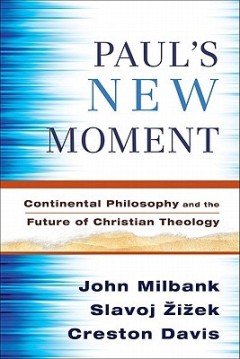
Paul's New Moment: Continental Philosophy and the Future of Christian Theology
The rediscovery of the apostle Paul by atheistic or agnostic European philosophers is one of the most striking recent developments in philosophy--and certainly one of keen interest to the church. These philosophers view Paul as having a revolutionary understanding of authority and politics. Bringing together Radical Orthodox theologian John Milbank, Slovenian philosopher Slavoj Zižek, and Cre…
- Edisi
- -
- ISBN/ISSN
- 9781587432279
- Deskripsi Fisik
- ix + 244 pg.; 27,5 cm.
- Judul Seri
- -
- No. Panggil
- 261.51 MIL p
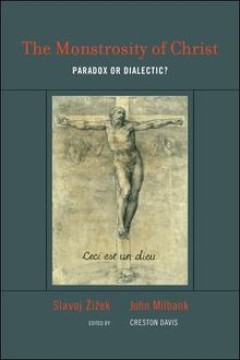
The Monstrosity of Christ: Paradox or Dialectic?
“What matters is not so much that Žižek is endorsing a demythologized, disenchanted Christianity without transcendence, as that he is offering in the end (despite what he sometimes claims) a heterodox version of Christian belief.”--John Milbank“To put it even more bluntly, my claim is that it is Milbank who is effectively guilty of heterodoxy, ultimately of a regression to paganism: in …
- Edisi
- -
- ISBN/ISSN
- 9780262012713
- Deskripsi Fisik
- 312 pg.; 27,5 cm.
- Judul Seri
- -
- No. Panggil
- 230 ZIZ m

The Parallax View
The Parallax View is Slavoj Žižek's most substantial theoretical work to appear in many years; Žižek himself describes it as his magnum opus. Parallax can be defined as the apparent displacement of an object, caused by a change in observational position. Žižek is interested in the "parallax gap" separating two points between which no synthesis or mediation is possible, linked by an "impos…
- Edisi
- -
- ISBN/ISSN
- 0262240513
- Deskripsi Fisik
- 429 pg.; 28 cm.
- Judul Seri
- -
- No. Panggil
- 199.4973 ZIZ p
 Karya Umum
  Filsafat
  Agama
Agama  Ilmu-ilmu Sosial
  Bahasa
  Ilmu-ilmu Murni
  Ilmu-ilmu Terapan
  Kesenian, Hiburan, dan Olahraga
  Kesusastraan
  Geografi dan Sejarah